

Plastic Pallet 1200×800 mm – Robust Semi-Hygiene Pallet with Open Deck and Stacking Rim for Export, Warehousing and Reusable Logistics
The 1200×800 mm plastic pallet 10367 is a robust semi-hygiene pallet in the European standard format for companies requiring a heavy-duty, clean and reusable load carrier for export, warehousing, production and internal logistics. Featuring an open deck, a continuous stacking rim, three full-length runners and a high load capacity, it combines a comparatively low tare weight with a stable construction for demanding industrial material flows.
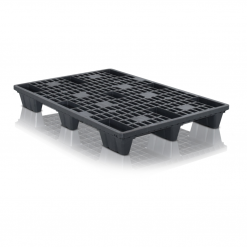
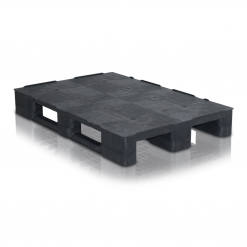
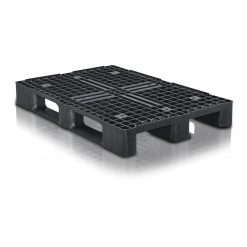
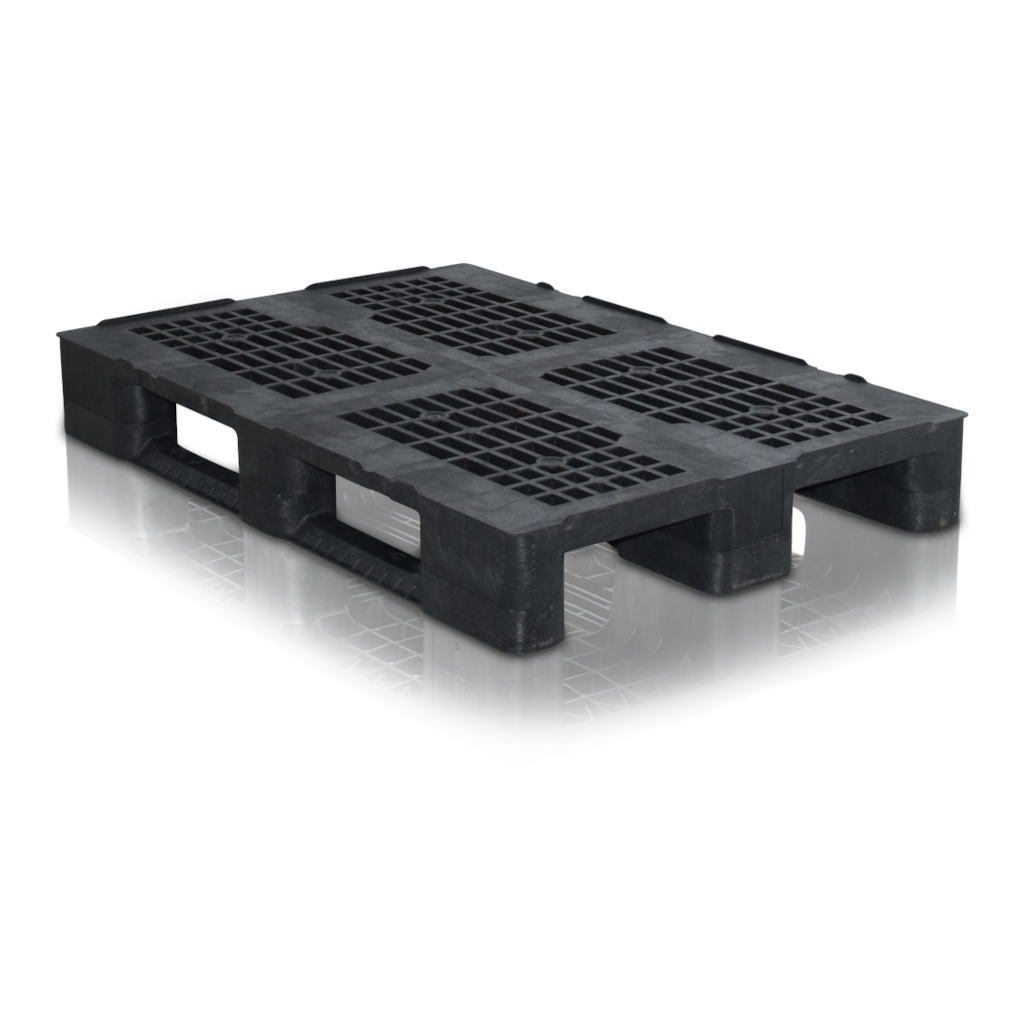
The open deck reduces material consumption and therefore the pallet’s weight compared with an otherwise identical pallet with a closed deck. At the same time, the open structure promotes air circulation around the load and allows water or residual moisture to drain away or evaporate more easily. This is particularly beneficial for robust packaging, containers, crates, cartons or goods that do not require a fully closed support surface.
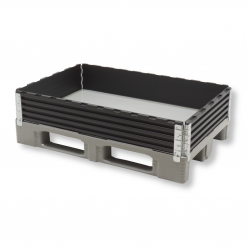
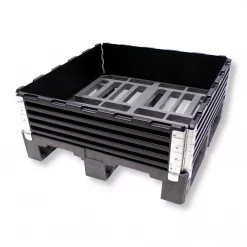
The continuous stacking rim provides an additional lateral boundary around the deck surface. It can help to centre compatible containers, pallet collars or purpose-matched load units on the pallet and reduce sideways movement during placement. This makes the plastic pallet 10367 particularly suitable for recurring reusable processes in which pallets are regularly loaded, stacked, transported, unloaded and returned.
As a semi-hygiene pallet, the 10367 is cleaner, splinter-free and more moisture-resistant than many conventional wooden pallets. However, it should not be regarded as equivalent to a fully enclosed cleanroom or hygiene pallet. Its strength lies in the combination of high load capacity, an open deck, good cleanability, a stacking rim and an economical tare weight. For applications with particularly stringent hygiene or cleanroom requirements, it is advisable to compare it with the 1200×800 mm Hygiene Plastic Pallet 10039.
Within the Plastic Union product range, the 10367 complements the 1200×800 mm plastic pallets category. There, companies can find further pallets in the Euro format, including lightweight export pallets, robust runner pallets, closed semi-hygiene pallets and specialised hygiene pallets. Where standard pallets do not fully meet the requirements of a process, custom-built plastic pallets and individually adapted load carriers can also be considered.
Technical Details of the 1200×800 mm Plastic Pallet 10367
- Product: 1200 x 800 mm Plastic Pallet / Semi-Hygienic Pallet / Export Pallet
- Item No.: 10367
- Dimensions: 1200 x 800 x 159 mm
- Weight: approx. 17 kg
- Static load capacity: 7,500 kg
- Dynamic load capacity: 1,750 kg
- Rack load capacity: 1,000 kg
- Base: 3 full-length runners
- Top deck: open deck
- Rim: with continuous stacking rim, optionally available without a rim
- Colour: black
- Material: Polyethylene (PE)
- Manufacturing: injection moulding
- Handling: suitable for compatible forklifts and pallet trucks
- Application: export, warehousing, production, shipping, reusable logistics, air freight, sea freight and internal transport
- Typical industries: food, beverages, chemicals, automotive, mechanical engineering, retail, general industry and logistics service providers
The stated load capacities apply to different load scenarios and must not be treated as equivalent. When selecting the pallet, factors including load distribution, temperature, duration of use, support conditions, the goods being carried, centre of gravity, racking geometry and the material handling equipment used must all be taken into account. Suitability should be assessed for the specific application, particularly in cases involving point loads, tall load units, uneven loading or automated conveyor systems.
Why the Open Deck of the Plastic Pallet 10367 Is Important
The open top deck is one of the key features of this 1200×800 mm plastic pallet. Unlike a closed deck, its surface incorporates defined openings. This reduces the amount of material required and therefore lowers the pallet’s tare weight. At approximately 17 kg, the 10367 remains easy to integrate into standardised warehousing, transport and reusable logistics processes despite its high load capacity.
The open deck structure also improves air circulation around the load unit. This can be beneficial for goods where residual moisture needs to escape or where a degree of ventilation is required. An open deck also offers advantages in areas where water may reach the pallet, as liquid is less likely to remain standing on a fully closed deck surface.
For robust crates, containers, canisters, industrial containers, sacks or sufficiently stable cartons, an open deck is often an economical solution. For very small packaging units, sensitive bags or goods with concentrated loads on their underside, however, it should be assessed whether a closed deck or an additional layer pad would be more suitable. Plastic layer pads and separator sheets can help to increase the supporting surface, separate individual layers or protect sensitive packaging.
The open deck is therefore not inherently a better or worse design principle than a closed deck. The application is the decisive factor. Where weight reduction, air circulation, water drainage and economical handling are the main priorities, the open-deck 10367 is often the more suitable choice. Where a largely closed, easy-to-wipe support surface and increased protection for the underside of the goods are required, the closed-deck 10369 may be the better option.
What Is the Function of the Continuous Stacking Rim?
The stacking rim forms a continuous raised edge around the perimeter of the top deck. It supports the defined positioning of goods, compatible containers or purpose-matched structures within the pallet footprint. Particularly in recurring processes, this can help to create more consistent load units and prevent lateral overhang.
When load units are stacked, the rim can also help to position a compatible upper unit more centrally. However, the stacking rim must not be regarded as the sole means of load securing. Whether and how loaded pallets may be stacked always depends on the goods, the stability of the packaging, the permitted stacking load, the position of the centre of gravity and the applicable operational safety requirements.
The stacking rim can be particularly useful with plastic containers, crates, stable cartons, pallet collars or dimensionally stable industrial containers. For loads with different dimensions, it should be checked whether the usable area within the rim is sufficient. Where the rim is not required for a particular process or the full deck surface needs to remain freely accessible, the pallet is also available without a rim.
In automated or semi-automated material flows, a clearly defined outer contour can be advantageous. However, sensors, conveyor systems, roller conveyors, chain conveyors, transfer points and centring devices must be matched to the specific pallet. The dimensions alone are not sufficient to determine reliably whether the pallet is suitable for a particular system.
What the Three Load Capacity Ratings of the 1200×800 mm Plastic Pallet Mean
When selecting an industrial or export pallet, three different load capacity ratings are generally considered: static load capacity, dynamic load capacity and racking load capacity. Each of these values describes a different loading scenario. A pallet capable of carrying a very high load while stationary must therefore not automatically be transported or used in racking with the same load.
Static Load Capacity: 7,500 kg
The static load capacity describes the permitted load when the pallet is stationary and standing on a sufficiently level, stable and load-bearing surface. Typical applications include block storage, buffer areas, staging zones or fixed storage locations where the pallet is not moved.
The plastic pallet 10367 has a static load capacity of 7,500 kg, placing it among the particularly heavy-duty plastic pallets in the Euro format. This high rating is especially relevant for heavy, evenly distributed load units that are to be stored on the floor or on another suitable supporting surface.
The static load capacity requires suitable load distribution. Narrow feet, sharp-edged components, heavy machine parts with only a few contact points, or loads positioned on one side can create significantly higher local stresses. In such cases, load-distribution plates, plastic sheets, layer pads or individually adapted supports may be required.
Dynamic Load Capacity: 1,750 kg
The dynamic load capacity describes the maximum load while the pallet is being moved, for example during transport with a suitable forklift, pallet truck or other material handling equipment. Lifting, accelerating, braking, cornering and setting down the pallet generate additional dynamic forces that do not occur when it is stationary.
The plastic pallet 10367 has a dynamic load capacity of 1,750 kg, making it suitable for numerous heavy-duty material flows in industry, production, warehousing and shipping. It is essential that the goods, packaging, centre of gravity, fork position, travel speed and transport route are compatible with both the pallet and the material handling equipment used.
Particular attention is required for tall, narrow or laterally sensitive load units. Ramps, thresholds, uneven floors, abrupt manoeuvres and fork tines that are not fully inserted can also increase the load on the pallet. The dynamic load capacity must therefore always be assessed in relation to the complete transport unit.
Racking Load Capacity: 1,000 kg
The racking load capacity is relevant when the pallet is used in pallet racking and is supported on only two bearing lines, for example on the rack beams. This loading situation differs significantly from full-surface floor storage because the pallet spans freely between the supports and may deflect under load.
The 1200×800 mm plastic pallet 10367 has a specified racking load capacity of 1,000 kg. This value is sufficient for many standardised warehousing applications, provided that suitable support conditions and the most even load distribution possible are ensured.
For racking applications, the rack type, beam spacing, support depth, load centre of gravity, temperature, storage duration, goods and any possible point loads must be considered together. In automated high-bay warehouses, cold-storage environments, areas with consistently high temperatures or applications involving special loads, suitability should be technically assessed in advance. A stated racking load capacity does not mean that every load unit can be stored in racking without further evaluation.
Advantages of the Plastic Pallet 10367 over Wooden Pallets
In international supply chains and recurring material flows, plastic pallets offer several advantages over conventional wooden pallets. Although wooden pallets are widely used, they may absorb moisture, splinter, contain nails or vary in their dimensions and condition. Plastic pallets, by contrast, are manufactured with reproducible geometry and are free from wood splinters and loose nails.
For international trade, ISPM 15 is particularly relevant. The official IPPC standard on ISPM 15 for wood packaging material in international trade sets out phytosanitary measures for packaging made from raw wood. As the 10367 is made of plastic, the pallet itself does not require ISPM 15 treatment such as heat treatment or fumigation.
This can simplify export processes because no corresponding wood-treatment certificate is required for the plastic pallet. However, the complete export packaging must still be suitable for the goods, the destination country, the mode of transport and the applicable regulations. Where wooden components, wooden crates or other raw-wood packaging materials are also used, additional requirements may continue to apply to those components.
Key Advantages over Conventional Wooden Pallets
- No ISPM 15 treatment is required for the plastic pallet.
- Splinter-free and therefore safer in day-to-day handling.
- No loose nails, screws or protruding metal parts.
- Moisture-resistant and weather-resistant.
- No swelling or increase in weight due to water absorption, as can occur with wood.
- Open deck structure for air circulation and water drainage.
- Easier to clean than many damaged or rough wooden surfaces.
- Dimensionally stable and reproducible geometry.
- Reusable in suitable reusable logistics processes.
- Consistent quality over numerous reuse cycles.
- Suitable for clean warehousing, production and shipping areas.
- Robust solution for export, industry and internal logistics.
Load Securing: The Pallet Forms the Basis of the Load Unit
A heavy-duty plastic pallet is an important component of a safe transport solution, but it does not replace professional load securing. The goods, packaging, centre of gravity, friction values, stacking height, securing equipment, vehicle, transport route and handling conditions must always be considered together.
The stacking rim of the 10367 can support the positioning of suitable load units, but it does not provide complete protection against slipping, tipping or falling. Depending on the goods, additional measures such as strapping, stretch film, shrink film, edge protection, lashing straps, layer pads, anti-slip materials, securing wedges or pallet frames may be required.
For road transport, recognised load-securing guidelines provide useful technical guidance. VDI 2700 on load securing for road vehicles is an established reference for planning safe transport operations. BG Verkehr also provides supplementary information on loading and securing.
BG Verkehr also provides guidance on load distribution and load securing to support the selection of suitable securing measures. BGHM likewise publishes information on load-securing requirements and outlines the organisational, technical and practical aspects of safe transport processes.
Plastic Union offers complementary products that can support the creation of safe and reproducible load units. These include anti-slip plastic layer pads, plastic pallet wedges for load securing, 1200×800 mm plastic pallet collars and further solutions for warehousing, packaging and transport.
Semi-Hygiene Pallet for Clean and Controlled Material Flows
The term semi-hygiene pallet refers to a plastic pallet that offers advantages over many open wooden or recycled pallets in terms of cleanliness, material properties and cleanability, without necessarily being designed as a fully enclosed cleanroom or full-hygiene pallet.
The plastic pallet 10367 features an open deck. This means it is not suitable for every highly sensitive hygiene application, but it can provide an economical alternative in many clean industrial, warehousing and packaging processes. Plastic is splinter-free, does not absorb water like wood and can be cleaned using suitable methods.
For food-processing companies, beverage manufacturers, packaging businesses and other sensitive industries, it is essential that the load carrier can be integrated into the company’s hygiene and cleaning concept. The German Federal Institute for Risk Assessment provides information on the HACCP concept. A pallet alone does not constitute a hygiene system, but it can form part of a controlled material flow.
The open structure facilitates water drainage and can support drying after cleaning. At the same time, it contains more open areas than a closed hygiene pallet. Whether the 10367 is suitable for a specific food, pharmaceutical or cosmetics application should therefore be assessed on the basis of the goods, the packaging, the cleaning method and the company’s internal quality requirements.
Material and Manufacture of the Plastic Pallet 10367
The plastic pallet 10367 is manufactured from high-quality polyethylene using an injection moulding process. During this process, the heated plastic is injected under pressure into a mould. This produces a reproducible pallet geometry with defined dimensions, runners, deck openings and reinforced areas.
Injection-moulded production is particularly suitable for recurring industrial applications because pallets within the same product series have a largely consistent form and function. In standardised material flows, these reproducible dimensions are important for applications such as roller conveyors, conveyor systems, racking, packaging stations and automated transfer points.
Polyethylene combines high impact strength with moisture resistance and resistance to many substances commonly encountered in industrial environments. These include numerous cleaning agents, oils and greases. However, the specific chemical resistance depends on the concentration, temperature, exposure time and combination of the substances used and should be assessed individually for critical applications.
Due to its material structure, polyethylene does not absorb water in the way that wood typically does. The pallet does not swell when exposed to moisture and therefore does not change its dimensions or weight to the same extent. This is particularly advantageous for export, sea freight, outdoor storage and changing climatic conditions.
The black version is UV-stabilised and designed for robust industrial processes. However, UV stabilisation cannot prevent all material ageing during unlimited outdoor storage. The actual service life depends on factors including solar exposure, temperature fluctuations, mechanical loads, cleaning, contact with chemicals and proper handling.
Handling with Forklifts and Pallet Trucks
The three full-length runners provide a stable base and allow the pallet to be handled using suitable material handling equipment. The plastic pallet 10367 can be accessed from two sides by forklift or pallet truck. Before use, it should be checked whether the fork spacing, fork height, fork length and load capacity of the equipment are suitable for both the pallet and the load unit.
When lifting the pallet, the fork tines should be inserted as fully and evenly as possible. Lifting from one side, using only partially inserted tines or picking up the pallet off-centre can place additional stress on both the pallet and the goods. This is particularly important for heavy load units or loads with a high centre of gravity.
The condition of the travel routes is also important. Uneven floors, thresholds, damaged ramps or abrupt transitions can generate dynamic load peaks. A pallet with a high load capacity can only be used reliably when the material handling equipment, travel route, speed and operating method are also appropriate for the load.
For automated conveyor systems, the runner position, clearance height, deck geometry, deflection, sensor detection and transfer points must be assessed in addition to the external dimensions. A pallet measuring 1200×800 mm is not automatically compatible with every existing system.
Stackability, Empty Pallet Returns and Warehouse Planning
When empty, multiple plastic pallets 10367 can be stacked on top of one another to save space. This reduces the storage footprint when holding stock, in buffer zones or when returning empty load carriers. Efficient empty-pallet logistics are particularly important in closed-loop reusable systems, as empty pallets often need to be transported over longer distances or staged for the next production cycle.
The continuous stacking rim supports the defined positioning of compatible elements on the deck surface. However, when stacking empty pallets, the permitted stacking height, the levelness of the floor and the applicable operational safety requirements must still be observed. Tall or unstable stacks of empty pallets may tip over if struck, placed on uneven ground or handled improperly.
In recurring reuse cycles, the pallet should not be considered in isolation. Important factors include the number of cycles, cleaning intervals, damage inspections, identification, stacking heights, storage locations, return times and available pallet stock. Well-planned pallet management can reduce search times, prevent bottlenecks and improve availability during ongoing operations.
In such processes, plastic pallets offer the advantage of reproducible geometry and a consistent design. Unlike mixed stocks of used wooden pallets, they are subject to fewer variations caused by broken boards, protruding nails or differing construction types.
Suitable for High-Volume Operations, Road Transport, Air Freight and Sea Freight
In export logistics, pallets are handled multiple times throughout the supply chain. They are staged in the warehouse, picked, packed, transported using material handling equipment, loaded onto lorries, transferred at terminals and handled again by the recipient. A dimensionally stable, heavy-duty pallet can help make these processes more consistent and reproducible.
The 1200×800 mm plastic pallet 10367 is particularly well suited to recurring high-volume operations because it combines the Euro format, high load capacity and a comparatively economical tare weight. The 1200×800 mm format is widely used in European warehousing, packaging and transport processes and can often be integrated into existing workflows.
In air freight, the weight of the load carrier plays an important role. At approximately 17 kg, the open-deck 10367 is lighter than the comparable version with a closed deck. For larger quantities, this difference in weight can affect the total shipment weight. At the same time, the pallet must remain sufficiently stable for the intended goods and handling processes.
For sea freight, intermediate storage and longer international transport routes, moisture is a key factor. Plastic does not absorb water like wood, does not swell and does not require ISPM 15 treatment. The open deck can also allow any liquid that enters to drain away, reducing the accumulation of standing water on the deck surface.
However, suitability for a specific export application does not depend on the pallet alone. Packaging, container stowage, climate protection, corrosion protection, load securing, stacking and destination-country requirements must all form part of a coordinated export concept.
Difference from the Plastic Pallet 10369 with a Closed Deck
Alongside the open-deck plastic pallet 10367, Plastic Union offers the 1200×800 mm plastic pallet 10369, a comparable semi-hygiene pallet with a closed top deck. Both versions feature the Euro format, three runners and high load capacity, but they are designed with different priorities in mind.
The 10367 stands out with its open deck, lower tare weight, good air circulation and improved water drainage. It is particularly suitable for robust goods, containers, industrial packaging and applications where a fully closed support surface is not required.
By contrast, the 10369 with a closed deck provides better protection for the underside of the goods against dust, dirt, falling small parts and moisture from below. Small packaging units or sensitive bags rest more evenly on a closed surface and cannot sink into deck openings.
Which version is more economical and technically suitable depends on the application. Where product protection, a closed support surface and cleanability are the main priorities, the 10369 is often the better choice. Where lower weight, ventilation, water drainage and a stacking rim are required, the 10367 offers clear advantages.
Difference Compared with the 10039 Hygiene Pallet
The 10367 is a robust semi-hygiene pallet with an open deck. For particularly stringent cleanliness requirements, direct food-processing areas, pharmaceutical applications, cleanrooms or defined hygiene zones, the 1200×800 mm Hygiene Plastic Pallet 10039 may be more suitable.
A specialised hygiene pallet typically has a more enclosed design and is specifically engineered for easy cleaning and the reduction of hard-to-access cavities. By contrast, the open-deck 10367 offers advantages in terms of weight, air circulation and liquid drainage.
For packaged food products, beverages, cartons and clean warehousing processes, the semi-hygiene pallet 10367 can be an economical solution. For unpackaged food, sterile products or clearly defined cleanroom processes, its suitability should be assessed as part of the company’s quality and hygiene concept.
Difference from the Lighter Euro Pallet 10361
For applications without increased hygiene requirements and with lower load-capacity needs, the lighter Euro pallet 10361 may be a more economical alternative. It is suitable for processes that require a robust plastic pallet in the Euro format but do not need the high load-capacity class of the 10367.
The choice between the two pallets should not be based solely on tare weight or purchase price. The decisive factors are load weight, racking use, cycle frequency, transport route, cleaning requirements, stacking concept and the required service life.
The 10367 is particularly suitable where high static load capacity, a stacking rim, an open deck structure and recurring industrial use need to be combined. By contrast, the 10361 can provide a lighter and more economical solution for less demanding material flows.
Industries and Typical Applications
Export Logistics and International Supply Chains
Export logistics require load carriers that are stable, dimensionally consistent and suitable for international use without additional wood treatment. As a plastic pallet, the 10367 is particularly well suited to recurring export shipments because the pallet itself does not require ISPM 15 treatment.
Typical applications include mechanical engineering supplies, consumer goods, packaged industrial products, spare parts, technical components, containers and goods regularly shipped by lorry, air freight or sea freight. The Euro format allows the pallet to be integrated into many existing packaging and transport systems.
Food, Beverage and Packaging Industries
In the food and beverage industries, load carriers are often used in clean, controlled material flows. The plastic pallet 10367 is splinter-free, moisture-resistant and easier to clean than many wooden pallets. Its open deck supports water drainage and air circulation.
The pallet may be suitable for packaged food products, beverage crates, cartons, outer packaging and production materials. For direct food contact, cleanroom applications or particularly stringent hygiene areas, it should be assessed whether a specialised hygiene pallet would be more appropriate.
Chemicals, Raw Materials and Technical Containers
In the chemicals and raw materials industries, canisters, sacks, cartons, crates and other industrial containers are handled. The combination of high static load capacity, an open deck and moisture-resistant plastic makes the 10367 a robust base for numerous heavy-duty material flows.
For hazardous substances, liquids and leakage risks, a pallet alone is not sufficient. Depending on the application, suitable spill-containment systems may be required. Plastic Union offers mobile spill pallets as well as IBC and KTC spill pallets for large containers.
Automotive and Mechanical Engineering
Automotive suppliers and mechanical engineering companies often work with defined load units, recurring parts flows and stringent process-safety requirements. The plastic pallet 10367 can be used for small load carriers, cartons, assemblies, spare parts, raw materials and packaged machine components.
The stacking rim can support centred positioning when used with compatible containers and structures. For sensitive components, painted parts or components with defined contact points, additional layer pads, compartment inserts or supports may be beneficial. Plastic Union offers plastic compartment inserts and dividers, as well as plastic sheets, foam sheets and rubber sheets for these applications.
Retail, Warehousing and Fulfilment
In retail warehouses, distribution centres and fulfilment operations, pallets are continuously picked, moved, temporarily stored and dispatched. The 10367 supports these workflows with its standardised format, stable runner base and high dynamic load capacity.
For recurring reuse cycles, a robust plastic pallet can be economical over the long term. It is reusable, moisture-resistant and dimensionally stable, allowing pallet inventories, storage locations and return processes to be planned more effectively.
Production and Internal Transport
In production, pallets are used not only for shipping but also for staging raw materials, packaging, semi-finished products and finished goods. Load units are moved between goods receipt, the production line, quality assurance, intermediate storage and dispatch.
The plastic pallet 10367 provides a robust and reproducible base for these applications. The open deck can be advantageous in ventilated material flows or in areas involving cleaning processes. The stacking rim helps position compatible containers or structures within the pallet footprint.
Agriculture, Horticulture and Moist Environments
Plastic pallets can also offer advantages in environments with elevated moisture levels. They do not absorb water like wood, do not swell and are weather-resistant. The open deck allows rainwater, cleaning water or process water to drain away.
Typical applications may include robust crates, packaged products, plant containers or other sufficiently stable load units. Suitability for the specific application depends on temperature, exposure to sunlight, contamination, cleaning requirements and load weight.
Combination with Layer Pads, Pallet Collars and Load Securing
Depending on the application, the plastic pallet 10367 can be combined with various accessories. Plastic layer pads can be used to separate individual product layers, provide better support for smaller packaging units or distribute the load more evenly across the open deck surface.
For smooth cartons, film-wrapped packaging or demanding transport routes, anti-slip layer pads can help increase friction between the individual layers. However, they do not replace complete load securing and must be matched to the goods, weight, surface and transport conditions.
Where lateral containment is required, plastic pallet collars and pallet frames can be a useful addition. They can help prevent goods from falling sideways and support the creation of reusable load units.
For rolls, spools, cylindrical components or other goods prone to rolling, plastic pallet wedges and securing wedges can be used. The specific design must be matched to the dimensions, weight, support geometry and transport loads.
For sensitive surfaces, foam, rubber or plastic supports can provide additional protection. Custom solutions can also be considered for special dimensions, load capacities, scanning zones, identification requirements or automated processes.
When Is the Plastic Pallet 10367 the Right Choice?
The 1200×800 mm plastic pallet 10367 is particularly suitable where several requirements need to be met at the same time: high static load capacity, a robust runner base, lower tare weight than a closed-deck version, air circulation, water drainage, a stacking rim and reusability.
It is not a simple lightweight or one-way pallet, but a heavy-duty industrial, reusable and export pallet. This makes it suitable for companies that manage recurring material flows with defined load units and are looking for a durable alternative to wooden pallets.
The 10367 is often a good choice for robust cartons, crates, canisters, industrial containers, bins and technical components. It is particularly economical where the goods do not require a closed support surface and the lower weight of the open-deck design can be utilised.
For very small packaging units, sensitive bags or goods that require complete protection from dust and moisture from below, the closed-deck 10369 may be more suitable. For direct food-processing areas, cleanrooms or applications with particularly stringent hygiene requirements, the Hygiene Pallet 10039 should be considered.
Not every application requires the high load-capacity class of the 10367. For lightweight one-way or export processes, the 1200×800 mm One-Way Plastic Pallet 10016 or the 1200×800 mm Lightweight Plastic Pallet 10015U may be more economical alternatives.
Important information for your inquiry
To enable Plastic Union to assess whether the plastic pallet 10367 is suitable for your application, the most precise possible information should be provided about the goods, weight, storage conditions, transport and process requirements. This information also makes it possible to determine whether the open-deck version, a closed pallet, a hygiene pallet or a custom solution would be the better choice.
- Type of goods and packaging used.
- Dimensions of the individual packaging units.
- Dimensions of the complete load unit.
- Total weight per pallet.
- Distribution of the load across the deck surface.
- Possible point loads or particularly small contact areas.
- Static floor storage, dynamic transport or racking applications.
- Rack type, beam spacing and support conditions.
- Planned stacking height for loaded and empty pallets.
- Transport Route: Internal, Road Freight, Air Freight, Sea Freight or Export
- Forklifts, pallet trucks or conveyor systems used.
- Requirements for air circulation and water drainage.
- Requirements for Cleaning, Hygiene and Product Protection
- Requirement for a stacking rim or a version without a rim.
- Required securing elements such as straps, layer pads or anti-slip materials.
- Planned Quantity and Required Delivery Date
Frequently Asked Questions about the 1200×800 mm Plastic Pallet 10367
What Is the 1200×800 mm Plastic Pallet 10367 Used For?
The plastic pallet 10367 is used for warehousing, transport, export, shipping, production and internal logistics. It is particularly suitable for robust cartons, crates, containers, industrial packaging, canisters and technical components that need to be transported on a heavy-duty pallet with an open deck.
Why Does the Pallet Have an Open Deck?
The open deck reduces material consumption and therefore the pallet’s tare weight. At the same time, it improves air circulation around the load and allows water or cleaning fluids to drain away. For goods that require a fully closed support surface, a closed-deck pallet may be more suitable.
What Is the Continuous Stacking Rim Used For?
The stacking rim supports the centred positioning of compatible containers, structures or load units within the pallet footprint. It can reduce lateral movement during placement, but it does not replace professional load securing.
Is the Pallet Also Available without a Stacking Rim?
Yes. The plastic pallet 10367 is optionally available without a rim. Which version is more suitable depends on the dimensions of the load, the required handling characteristics and the planned combination with containers, pallet collars or layer pads.
Is the Plastic Pallet Suitable for Export?
Yes. As the 10367 is made of plastic, the pallet itself does not require ISPM 15 treatment for wood packaging material. This can simplify international shipping processes. However, the complete export packaging must still be suitable for the goods, the mode of transport, the destination country and the applicable regulations.
What Does the Static Load Capacity of 7,500 kg Mean?
The static load capacity describes the load while the pallet is stationary, for example in block storage on a level surface. With suitable and as even a load distribution as possible, the 10367 has a static load capacity of up to 7,500 kg. Point loads and one-sided loading must be assessed separately.
What Is the Dynamic Load Capacity?
The dynamic load capacity is 1,750 kg. This value is relevant when the pallet is moved using a forklift, pallet truck or other suitable material handling equipment. The travel route, speed, centre of gravity and load distribution all influence the actual stresses placed on the pallet.
Can the Plastic Pallet Be Used in Pallet Racking?
The pallet has a specified racking load capacity of 1,000 kg. Whether it is suitable for a particular racking system depends on the rack type, beam spacing, support depth, temperature, storage duration, goods and load distribution. Its suitability for racking should therefore be assessed for the specific application.
Why Is the Racking Load Capacity Lower than the Static Load Capacity?
In racking, the pallet is often supported only by two beams or support lines. The central area is not fully supported and may deflect under load. With static floor storage, by contrast, the pallet rests on a larger supporting surface, allowing a higher load.
Is the 10367 a Hygiene Pallet?
The 10367 is a semi-hygiene pallet. It is splinter-free, moisture-resistant and easy to clean, but features an open deck. For particularly stringent hygiene, food-processing or cleanroom requirements, a specialised hygiene pallet such as the 10039 may be more suitable.
What material is the pallet made from?
The plastic pallet 10367 is manufactured from polyethylene using an injection moulding process. The material is robust, moisture-resistant and suitable for recurring industrial applications. Its specific resistance to chemicals should be assessed when used with critical substances.
Is the Black Plastic Pallet UV-Resistant?
The black version is UV-stabilised and can therefore also be used during transport or for temporary outdoor storage. However, prolonged exposure to sunlight, high temperatures and severe weather conditions can still cause plastics to age over time.
Can the Pallet Be Reused?
Yes. The 10367 is designed for recurring industrial applications and reusable logistics processes. With proper use, regular inspection and suitable loading, it can be used over numerous reuse cycles.
How Is the Pallet Handled?
The three full-length runners allow the pallet to be handled from two sides using suitable forklifts and pallet trucks. The fork spacing, fork length and load capacity of the equipment used must be compatible with both the pallet and the load unit.
Can the Pallet Be Combined with Layer Pads?
Yes. Plastic layer pads can increase the supporting surface for small packaging units, separate product layers and protect sensitive undersides. For smooth packaging, anti-slip layer pads may also be beneficial.
Can a Plastic Pallet Collar Be Used?
Depending on the dimensions and design, suitable pallet collars can be used to provide lateral containment for the load unit. Compatibility with the stacking rim, deck surface and goods should be checked in advance.
What Is the Difference Compared with the Closed-Deck Plastic Pallet 10369?
The 10367 has an open deck, offering lower weight, air circulation and water drainage. The 10369 has a closed deck, providing greater protection from dust, dirt, moisture and small items from below. The most suitable version depends on the goods and the process.
What Is the Difference Compared with the 10039 Hygiene Pallet?
The 10367 is an open-deck semi-hygiene pallet for industrial, warehousing and export processes. The 10039 is more specifically designed for stringent hygiene requirements, food-processing areas and cleanroom applications. For sensitive processes, suitability should be assessed against the company’s hygiene concept.
Which Industries Is the Plastic Pallet Particularly Suitable For?
The 10367 is particularly suitable for export logistics, food and beverage packaging, chemicals, automotive, mechanical engineering, retail, warehouse logistics, fulfilment and internal production processes. This is provided that the goods, load weight and supporting surface are compatible with the open deck structure.
Can the Pallet Be Used for Air Freight and Sea Freight?
Yes. Its comparatively economical tare weight is beneficial for air freight, while its moisture resistance and water drainage offer advantages for sea freight and changing climatic conditions. However, the complete load unit must still be packaged and secured appropriately for transport.
Can Plastic Union Help Select the Right Pallet?
Yes. Based on the goods, weight, dimensions, transport route, racking use, material handling equipment, hygiene requirements and required quantity, Plastic Union can assess whether the 1200×800 mm plastic pallet 10367 is suitable or whether a different pallet, accessories or a custom solution would be more appropriate.
Enquire Now about the 1200×800 mm Plastic Pallet 10367
Are you looking for a robust, heavy-duty 1200×800 mm plastic pallet with an open deck, three runners and a continuous stacking rim for export, warehousing, production or reusable logistics? The plastic pallet 10367 combines a static load capacity of 7,500 kg with a tare weight of approximately 17 kg and is suitable for a wide range of demanding material flows.
The open deck supports air circulation and water drainage, while the stacking rim facilitates the defined positioning of compatible load units. For applications requiring a closed support surface, the plastic pallet 10369 is available as an alternative. Where particularly stringent hygiene requirements apply, the Hygiene Pallet 10039 should be considered.
Send us your enquiry with the required quantity, goods, weight, application, racking requirements and preferred delivery date. We will be pleased to advise you on plastic pallets, semi-hygiene pallets, export pallets, layer pads, pallet collars, load securing and possible custom solutions.
Request a quote now: info@plasticunion.com