


Plastic pallets for storage, transport and export
Durable alternative to wooden pallets
Plastic pallets are the hygienic, robust and sustainable alternative to wooden pallets. They are suitable for storage, transport, export and reusable systems and are available in many formats and versions. Thanks to their high load capacity, weather resistance and long service life, they are ideal for industry and trade.

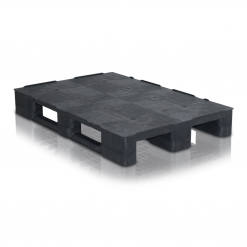
Plastic pallets – robust load carriers for storage, transport, export and reusable logistics
Plastic pallets are durable, dimensionally stable and reusable load carriers for storage, transport, production, shipping, export and internal material flows. As an alternative to traditional wooden pallets, they are used in numerous industries – from food and pharmaceuticals to automotive, mechanical engineering and chemicals, as well as retail, distribution and international logistics.
Plastic Union offers plastic pallets in different dimensions, weight classes, deck designs and base configurations. The range extends from lightweight export and nestable pallets to reusable, industrial and container pallets, as well as hygienic pallets, heavy-duty pallets and individually designed special pallets. Depending on the application, versions with feet, runners, open or closed decks, stacking rims, anti-slip elements or special support geometries can be considered.
In everyday language, plastic pallets are sometimes also referred to as plastics pallets. Other common search terms and technical designations include plastic Euro pallet, industrial pallet, export pallet, one-way pallet, reusable pallet, pool pallet, nestable pallet, display pallet, half pallet, quarter pallet, container pallet, block pallet, hygienic pallet and chemical pallet. For technical selection, however, the designation is not decisive. What matters is the interaction between pallet format, material, tare weight, base design, deck design, static load, dynamic load, racking load, goods and the conveyor equipment used.
What types of plastic pallets are available?
Plastic pallets differ not only in their dimensions. Design, material, load class, base structure and intended logistics process determine which pallet is suitable for a specific application. In addition to standardized industrial formats, special dimensions and fully customized plastic pallets can also be produced.
Plastic Euro pallets and pallets in Euro format 1200x800 mm
1200x800 mm plastic pallets correspond in their nominal dimensions to the Euro pallet format widely used in Europe. They are suitable for numerous standardized storage, transport, order-picking and distribution processes and can serve as a base for suitable plastic pallet collars and other packaging systems.
However, a plastic pallet measuring 1200x800 mm is not automatically an EPAL Euro pallet or an exchangeable pallet within the traditional wooden pallet pool. Format, construction, approval and exchange criteria must be considered separately.
Half pallets 800x600 mm
800x600 mm plastic pallets – also specified as 600x800 mm depending on orientation – are often used as half pallets or half Euro format. They are suitable, among other things, for retail, store deliveries, displays, smaller load units, order picking and internal material staging.
Quarter pallets and display pallets 600x400 mm
600x400 mm plastic pallets have a particularly compact footprint and are often used as quarter pallets, 1/4 pallets or display pallets. This format is particularly suitable for sales displays, point-of-sale applications, smaller quantities of goods and direct presentation in retail.
The 600x400 mm dimension also plays an important role as a basic logistics module for coordinating packaging and load units.
Special format 800x400 mm – 1/3 Euro pallet for automotive and special applications
In addition to common standard formats, Plastic Union has also produced plastic pallets in the special 800x400 mm format for customer-specific applications. The footprint corresponds exactly to one third of the classic 1200x800 mm Euro format, which is why this size can also be described as a 1/3 Euro format or 1/3 Euro pallet.
The narrow 800x400 mm format can be particularly interesting for automotive processes, specially matched components, limited storage or installation spaces and applications in marine outfitting. Thanks to its reduced width, load units can be adapted to products and processes for which an 800x600 mm half pallet or a 1200x800 mm Euro pallet would be unnecessarily large.
The 800x400 mm plastic pallet is not a generally standardized Euro pallet format, but a special design evaluated and manufactured for the specific application. Relevant criteria include the goods, weight, load distribution, support points, required base design, conveyor equipment, available space and quantity required. Other customer-specific pallet dimensions can also be evaluated on request.
Square pallets 800x800 mm
800x800 mm plastic pallets are compact square pallets for specific load units. They can be an interesting alternative to the longer Euro pallet, particularly for coils, rolled goods, drums, barrels or other round or approximately square goods.
CP5 format 760x1140 mm
Plastic pallets measuring 760x1140 mm are based on the dimensions of the CP5 pallet. This comparatively narrow format can be particularly suitable for certain bagged goods, cartons, container processes and chemical supply chains.
Container pallets 1100x1100 mm
1100x1100 mm plastic pallets are square container and industrial pallets widely used in international goods flows and in parts of the Asian market. This format can be considered when planning container loading, bagged goods, cartons and other compact load units.
Industrial pallets 1200x1000 mm
1200x1000 mm plastic pallets – also specified as 1000x1200 mm depending on orientation – are among the internationally common industrial pallet formats. They are used in industry, automotive, chemicals, retail, storage and export.
The 1200x1000 mm format is one of the principal dimensions for flat pallets covered by ISO 6780 for international material handling.
Container and chemical pallets 1140x1140 mm
1140x1140 mm plastic pallets are square container pallets for sea freight, export and industrial logistics. This format is also used for common chemical pallet formats such as CP3, CP8 and CP9.
Whether a specific plastic pallet is actually suitable as a CP pallet for a particular chemical process must be checked based on its construction, load capacity and the requirements of the relevant process. The dimensions alone do not constitute technical approval.
CP4 and CP7 formats 1100x1300 and 1300x1100 mm
The dimensions 1100x1300 mm and 1300x1100 mm are used, among other things, for the CP4 and CP7 chemical pallet formats. These larger rectangular pallets can be used for bagged goods, industrial packaging units and industry-specific material flows.
Plastic pallets 1200x1200 mm
1200x1200 mm plastic pallets offer a large square loading surface. This format can be particularly interesting for Big Bags, FIBCs, drums, barrels, bulk packaging and other large or heavy load units.
Whether a square 1200x1200 mm pallet is more economical than a 1200x800 mm or 1200x1000 mm pallet depends on the goods, load distribution, available floor space, transport equipment, container or vehicle utilization and warehouse layout.
Custom plastic pallets and special pallets
If standard dimensions do not match the goods or the process, custom-built plastic pallets can be considered. A custom-made plastic pallet for special and heavy-duty applications is also available for customer-specific projects.
Custom pallets, adapter pallets, heavy-duty pallets and other special constructions can be adapted to containers, KLTs, GLTs, trays, conveyor equipment, robotics, AGV or AMR systems, specific components or special support geometries. Formats outside standard pallet dimensions – for example 800x400 mm – can also be evaluated depending on application, construction and quantity.
Designs and versions of plastic pallets
Runner pallets
Depending on their design, runner pallets can have two, three or more runners or a perimeter base. Continuous runners can improve support and are relevant for many applications involving forklifts, pallet trucks, conveyor systems or racking.
Pallets with feet
Lightweight plastic pallets and display pallets are often designed with several feet. Depending on their construction, such pallets may be stackable or nestable. The exact fork accessibility and suitability for pallet trucks, forklifts or roller conveyors must be checked for the respective model.
Nestable pallets and nestable plastic pallets
Nestable pallets are designed so that empty pallets can partially fit inside one another. This reduces the volume of the empty pallet stack. Nestable pallets are therefore particularly suitable for export, one-way processes, empty pallet storage and applications where the space required by empty load carriers has a significant economic impact.
Block pallets
Block pallets or plastic block pallets have a corresponding base design and, depending on their construction, can be accessed from several sides. They are mainly used for robust industrial, storage and reusable applications. Whether a pallet is suitable for racking, conveyor systems or automated equipment depends on the specific design.
Hygienic pallets
Hygienic pallets often have closed or particularly easy-to-clean surfaces and are designed to minimize areas in which dirt can accumulate. They can be suitable for food, beverages, pharmaceuticals, cosmetics and other sectors with increased hygiene requirements.
However, the designation “hygienic pallet” does not automatically mean that every version is approved for direct food contact, cleanroom use or GMP processes. Material, design, cleaning methods and any required declarations of conformity or approvals must be checked separately for the relevant process.
One-way pallets and export pallets
Lightweight plastic pallets are often used as one-way pallets or export pallets. The term “one-way” primarily describes the logistics process and does not necessarily mean that an undamaged pallet can technically only be used once.
Plastic is particularly attractive for international export because the international ISPM 15 standard regulates measures for packaging material made from raw wood. Plastic pallets are not made of raw wood and therefore do not require ISPM 15 treatment of the pallet.
Reusable pallets and pool pallets
Robust plastic pallets can be used in recurring reusable cycles, internal loops, supplier loops or pallet pools. In addition to load capacity, service life, return transport, cleaning, identification, repair strategy and loss rate are important economic factors in such processes.
Chemical pallets and CP pallets
Chemical pallets are used for standardized material flows in the chemical industry and related sectors. Common designations include CP1, CP3, CP4, CP5, CP6, CP7, CP8 and CP9.
Common base dimensions include:
- CP1 and CP6: 1200x1000 mm
- CP3, CP8 and CP9: 1140x1140 mm
- CP4: 1100x1300 mm
- CP5: 760x1140 mm
- CP7: 1300x1100 mm
The specific suitability of a plastic pallet as a chemical pallet must be evaluated for the individual product and application. Geometrical conformity with a CP format alone does not confirm any particular approval, exchangeability or suitability for dangerous goods.
Open or closed deck?
Plastic pallets can be designed with an open, perforated, structured or closed top deck. The most suitable deck design depends on the goods, cleaning requirements, weight, air circulation, liquid drainage, point loads and conveyor equipment used.
Open deck: often optimized for lower weight and used for many export, industrial and reusable pallets.
Closed deck: can simplify cleaning and is often considered for hygienic, pharmaceutical, food or sensitive industrial applications.
Anti-slip version: anti-slip pads or friction-enhancing surfaces can support the positioning of the goods. However, they do not replace application-specific load securing.
Stacking rim: a continuous or partial rim can help position compatible containers or packaging. A stacking rim is also not automatically a complete load-securing solution.
Materials: HDPE, PE, PP, virgin material or recycled material
Depending on the model and requirements, plastic pallets can be manufactured from polyethylene, HDPE, polypropylene or suitable plastic blends. Recycled material can also be used for many technical applications.
The most suitable material depends, among other things, on temperature, mechanical loads, contact with substances, cleaning agents, hygiene requirements and the intended service life. For direct contact with food or other regulated applications, the specific suitability of the material must be confirmed separately.
Plastic pallets made from single-grade or appropriately processable materials can be sent for material recycling at the end of their service life where suitable take-back and recycling routes are available. Whether and to what extent a particular pallet contains recycled material or can be recycled should be assessed on a product-specific basis.
Advantages of plastic pallets compared with wooden pallets
Whether plastic or wood is the more economical choice depends on the specific process. Plastic pallets can offer advantages particularly in recurring cycles, humid environments, cleaning processes, automation and export.
- splinter-free surface without protruding nails
- low moisture absorption of the plastic material
- dimensionally stable and reproducible geometry within a product range
- easy to clean depending on design
- suitable for reusable and pooling processes
- lightweight export and nestable pallets available
- different load and weight classes available
- open and closed deck designs available
- versions with feet, runners or perimeter bases
- no ISPM 15 treatment required for the plastic pallet
- versions suitable for automated processes available
- special materials and designs possible for specific applications
Correctly distinguish static load, dynamic load and racking load
The selection of a plastic pallet should not be based solely on its external dimensions. It is essential to determine the type of load situation for which the pallet is intended.
Static load
Static load describes the load on a stationary pallet placed on a suitable, level and sufficiently load-bearing surface. It must not automatically be transferred to transport or racking applications.
Dynamic load
Dynamic load describes the intended load while the pallet is being moved using suitable material-handling equipment. The actual stress is influenced, among other things, by load distribution, center of gravity, travel route, speed, temperature and the condition of the pallet.
Racking load
Racking load describes the load-bearing capacity when the pallet is supported in a defined manner in pallet racking. For example, the pallet may rest only on two rack beams. This load case differs fundamentally from static floor storage with full-surface support.
A high static load rating therefore does not automatically mean that a pallet can be used in high-bay racking. For rack storage, the specified racking load, beam spacing, load distribution, temperature, storage duration and any reinforcements must be taken into account.
Plastic pallets for conveyor systems and automated warehouses
Dimensionally stable plastic pallets can be suitable for roller conveyors, chain conveyors, pallet magazines, automated high-bay warehouses, shuttle systems, robotic handling, AGVs or AMRs. External dimensions alone, however, do not guarantee compatibility with the system.
Before series approval, the following points should be checked, among others:
- base design and runner spacing
- fork entry height and openings
- support points on roller or chain conveyors
- deflection under load
- dimensional tolerances
- sensors and detectability
- temperature range
- pallet magazines and de-stacking
- rack type and beam spacing
- position of the goods and center of gravity
Applications by industry
Food and beverage industry
Because of their splinter-free and easy-to-clean design, plastic pallets can be suitable for packaged food, beverages, refrigerated areas, production and distribution. Hygienic pallets with appropriately designed surfaces can be integrated into defined cleaning and hygiene concepts.
Suitability for direct food contact or for a specific HACCP-based process must nevertheless be checked based on the actual material, the pallet and the company’s hygiene concept.
Pharmaceuticals, cosmetics and medical technology
In pharmaceutical, cosmetics and medical technology processes, plastic pallets can offer advantages in terms of cleaning, dimensional stability and splinter-free surfaces. Whether a pallet is suitable for GMP, cleanroom or other regulated processes must be checked against the respective material, cleaning and approval requirements.
Automotive industry and suppliers
Dimensionally stable reusable, industrial and pool pallets can be suitable for automotive, mechanical engineering and supplier logistics. They can be combined with standardized containers, KLTs, GLTs, plastic grid inserts and dividers or other internal positioning systems.
For particularly narrow components, defined installation spaces or customer-specific material flows, a special pallet in the 800x400 mm 1/3 Euro format can also be considered. Plastic Union has produced this format, among other things, for automotive applications.
Marine outfitting and special maritime applications
In marine outfitting, maritime projects and other applications with limited storage or installation space, standard pallets may be too large. For such projects, customer-specific plastic pallets, for example in the special 800x400 mm format, can be adapted to the goods and the available space.
The specific design is evaluated based on dimensions, goods weight, load distribution, transport route, handling and required support points.
Chemical industry
For chemical applications, industrial pallets, container pallets and pallets in various CP-related dimensions are available depending on the process. Chemical resistance depends on the plastic used, the medium, concentration, temperature and exposure time and must be assessed for the specific application.
A plastic pallet alone is neither a spill containment tray nor approved dangerous-goods packaging, nor is it automatically a storage solution compliant with German water law. For liquid hazardous substances, the required containment, storage and securing systems must be designed separately. For applications outside Germany, the applicable European, national and, where relevant, local regulations must also be checked.
Export and international logistics
Lightweight one-way, export and nestable plastic pallets can be suitable for air freight, sea freight and international distribution. Plastic pallets themselves do not require treatment under ISPM 15 because this international standard regulates packaging material made of raw wood.
Regardless of this, all other requirements of the destination country, mode of transport, goods and, where applicable, dangerous-goods regulations must be checked for export processes.
Retail, e-commerce and distribution
Display pallets, quarter pallets, half pallets and lightweight plastic pallets are suitable for store logistics, sales areas, promotional goods, e-commerce, fulfillment and distribution centers. Small pallet formats allow goods to be pre-picked in the warehouse and transported directly to the point of sale.
Pallet dimensions and applications at a glance
- 600x400 mm – quarter pallet, 1/4 pallet, display pallet and point of sale
- 800x400 mm – 1/3 Euro format or 1/3 Euro pallet as a special design, including for automotive, marine outfitting and customer-specific applications
- 800x600 mm – half pallet, half Euro format, retail and order picking
- 800x800 mm – square pallet for coils, rolled goods and drums
- 760x1140 mm – CP5-related format for industry-specific applications
- 1100x1100 mm – square container and industrial pallet
- 1200x800 mm – Euro format, plastic Euro pallet, storage and distribution
- 1200x1000 mm – industrial pallet, ISO format and CP1/CP6-related applications
- 1140x1140 mm – container pallet and CP3/CP8/CP9-related applications
- 1100x1300 mm – CP4-related format
- 1300x1100 mm – CP7-related format
- 1200x1200 mm – square pallet for Big Bags, drums and large load units
- special dimensions and custom construction – custom pallets and customer-specific load carriers
Even if no dedicated product category has yet been published for certain special or industrial formats, corresponding plastic pallets can still be requested. Depending on the requirements, an existing model, a technically comparable version or a customer-specific special pallet can be evaluated.
Combine plastic pallets with pallet collars and accessories
A pallet is often only the load-bearing base of a complete load unit. Depending on the goods, it can be combined with additional components to form a coordinated storage, transport or reusable system.
- plastic pallet collars for lateral containment of load units
- plastic grid inserts and dividers for structured internal compartmentalization
- plastic pallet layer pads, separator sheets and layer pads for separating levels and protecting surfaces
- plastic stacking corners for suitable modular stacking concepts
- support cradles for shafts, pipes, rolls and other round materials
- plastic pallet chocks for goods that may roll
The most suitable combination depends on dimensions, weight, center of gravity, support surface, sensitivity, transport route, stacking and the required load securing.
Frequently asked questions about plastic pallets
What are the dimensions of a Euro pallet?
The widely used Euro pallet format has a footprint of 1200x800 mm, or 800x1200 mm depending on orientation. EPAL uses these dimensions for the EPAL Euro pallet. Plastic pallets can be manufactured in the same nominal dimensions, but this does not automatically make them EPAL Euro pallets or exchangeable pool pallets.
What are the dimensions of a half pallet?
In European retail, the 800x600 mm format is often referred to as a half pallet. It corresponds to half the footprint of the 1200x800 mm Euro format and is widely used for store logistics, displays and smaller load units.
What are the dimensions of a quarter pallet?
The 600x400 mm format is often referred to as a quarter pallet or 1/4 pallet. It is particularly suitable for display and point-of-sale applications.
What is an 800x400 mm 1/3 Euro pallet?
A plastic pallet measuring 800x400 mm has a footprint of 0.32 m² and therefore corresponds exactly, in terms of area, to one third of the classic 1200x800 mm Euro format. This size can therefore be described as a 1/3 Euro format or 1/3 Euro pallet.
However, it is not a generally standardized Euro pallet format. Plastic Union has produced 800x400 mm plastic pallets as customer-specific special designs, including for automotive, marine outfitting and other technical applications. Comparable projects can be evaluated based on the goods, weight, support points, quantity and logistics process.
Can an 800x400 mm plastic pallet be requested?
Yes. The 800x400 mm format can be requested as a special pallet or custom-made plastic pallet. For technical evaluation, information such as the dimensions of the goods, weight, load distribution, required base design, application, conveyor equipment and quantity should ideally be provided.
What is an ISO pallet?
ISO 6780 describes principal dimensions and tolerances for flat pallets used in international material handling. It includes widely used pallet dimensions such as 1200x1000 mm and 1200x800 mm. In the market, 1200x1000 mm in particular is often referred to as an ISO or industrial pallet format.
What does static load mean?
Static load applies to a stationary pallet under defined support and load conditions. It must not be equated with dynamic load or racking load.
What does dynamic load mean?
Dynamic load relates to moving a loaded pallet using suitable material-handling equipment. Load distribution, center of gravity, floor conditions and handling influence the actual stress.
What does racking load mean?
Racking load is the load-bearing capacity specified for defined storage in pallet racking. Since a pallet in a rack often rests only on a limited number of support lines, this load case is structurally more demanding than full-surface floor storage.
Are plastic pallets suitable for high-bay racking?
Only if the specific pallet is designed for the intended racking application. A static load rating alone is not sufficient. Racking load, beam spacing, load distribution, temperature, storage duration and any reinforcements must be checked.
Are plastic pallets more hygienic than wooden pallets?
Plastic pallets have a splinter-free surface that is relatively insensitive to moisture and, depending on their design, can be easy to clean. Their actual hygienic suitability nevertheless depends on the deck design, material, level of contamination, cleaning process and the requirements of the relevant process.
Are plastic pallets HACCP or GMP compliant?
A plastic pallet is not automatically HACCP or GMP compliant solely because of its material. It can form part of a corresponding hygiene or quality concept if the material, design, cleaning and internal approval meet the relevant requirements.
Do plastic pallets require ISPM 15 treatment?
No. A plastic pallet itself does not require ISPM 15 treatment intended for raw wood. ISPM 15 regulates phytosanitary measures for packaging material made from raw wood in international trade. Other import, export or product-specific requirements may apply independently of this standard.
Are plastic pallets recyclable?
Many plastic pallets made from suitable PE or PP materials can be recycled as material after their service life. Actual recyclability depends on material composition, any inserts, contamination and the available recycling infrastructure.
Which pallet is suitable for coils and drums?
For compact rolled goods, coils or drums, an 800x800 mm plastic pallet can be an interesting option. For large drums, Big Bags or bulk packaging, a square format of 1140x1140 mm or 1200x1200 mm may also be suitable. The choice must be based on diameter, weight, center of gravity and load distribution.
Which plastic pallet is suitable for export?
Lightweight one-way pallets, nestable pallets, container pallets or robust reusable pallets are often used for export processes. The optimum format depends on the destination country, mode of transport, goods, container or vehicle utilization and whether a return process is planned.
Which plastic pallet is suitable for automated conveyor systems?
Reproducible dimensions are advantageous for automated systems. Nevertheless, the base design, runners, deck geometry, deflection, support surfaces, sensors, tolerances and process speed must be matched to the existing equipment.
What special dimensions are possible for plastic pallets?
Special pallets are not necessarily limited to standard pallet formats. Depending on the design, dimensions, support surfaces, raised edges, base structures and securing elements can be adapted to the specific goods. For a custom-made plastic pallet, it is advisable to provide as much information as possible about dimensions, goods weight, load distribution, application and quantity.
Further information on pallet formats and export
- EPAL – Product data sheets for Euro pallets, half pallets and CP pallets
- ISO 6780 – Principal dimensions and tolerances of flat pallets
- ISO 3394 – Dimensional modules for transport packaging and load units
- IPPC – ISPM 15 for raw wood packaging material in international trade
The standards, guidelines and external technical information mentioned above are provided for general orientation. The actual suitability of a pallet must always be evaluated based on the specific product, goods, load, storage and transport conditions and, where applicable, relevant industry-specific or legal requirements.
Legal and technical note for Germany and other countries
Where this page mentions or refers to German legal provisions, technical rules, authorities, German accident insurance institutions or other national requirements, these references relate to the legal or technical framework applicable in Germany.
For transport, storage, export, food contact, chemical applications, hazardous substances, occupational safety, racking applications, conveyor systems or other applications in other countries, the applicable European, national and, where relevant, local regulations, standards, approvals and technical requirements must be checked separately.
Requirements may vary depending on the country, industry, goods, mode of transport, vehicle, storage technology, material, pallet design and specific application. Information relating to pallet formats, load capacities, CP-related dimensions, hygiene, ISPM 15 or other technical characteristics therefore does not replace application-specific verification of the complete load unit or logistics system.
Select plastic pallets according to the application
The technically and economically most suitable pallet is not automatically the largest or strongest version. For selection, it is advisable to have the most specific process data possible:
- dimensions and weight of the goods
- load distribution and possible point loads
- static storage, transport or racking application
- rack type and beam spacing
- forklifts, pallet trucks and conveyor equipment
- automation and sensors
- temperature and environmental conditions
- cleaning and hygiene requirements
- export and destination country
- one-way, reusable or pooling process
- empty return and nestability
- required stacking rim or anti-slip equipment
- required standard or special format
- required quantity
Request plastic pallets now
Are you looking for plastic pallets for storage, transport, export, production or reusable logistics? Whether you need a 1200x800 mm plastic Euro pallet, an 800x600 mm half pallet, a 600x400 mm display pallet, an 800x400 mm 1/3 Euro pallet as a special design, a 1200x1000 mm industrial pallet, an 800x800 mm square pallet, a 1100x1100 mm or 1140x1140 mm container pallet, a chemical pallet, CP pallet, nestable pallet, hygienic pallet, block pallet, heavy-duty pallet or a fully customized special pallet – we will work with you to determine which dimensions and design are technically suitable for your process.
Plastic pallets in formats such as 760x1140 mm, 1100x1300 mm, 1300x1100 mm or 1200x1200 mm can also be requested, even if no dedicated product category has yet been published for these dimensions. Depending on the application, we can evaluate existing solutions, comparable versions or a customer-specific design.
On request, we consider not only the pallet but the complete load unit with pallet collars, grid inserts and dividers, layer pads, stacking corners, support cradles and pallet chocks.
For a technical pre-selection, please ideally provide the pallet format, goods weight, load distribution, application, racking requirements, conveyor equipment, quantity and any special requirements.
Contact: info@plasticunion.com