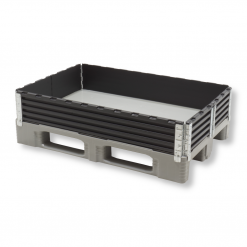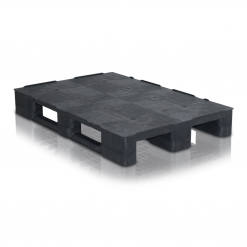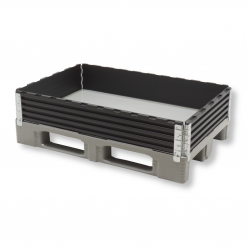


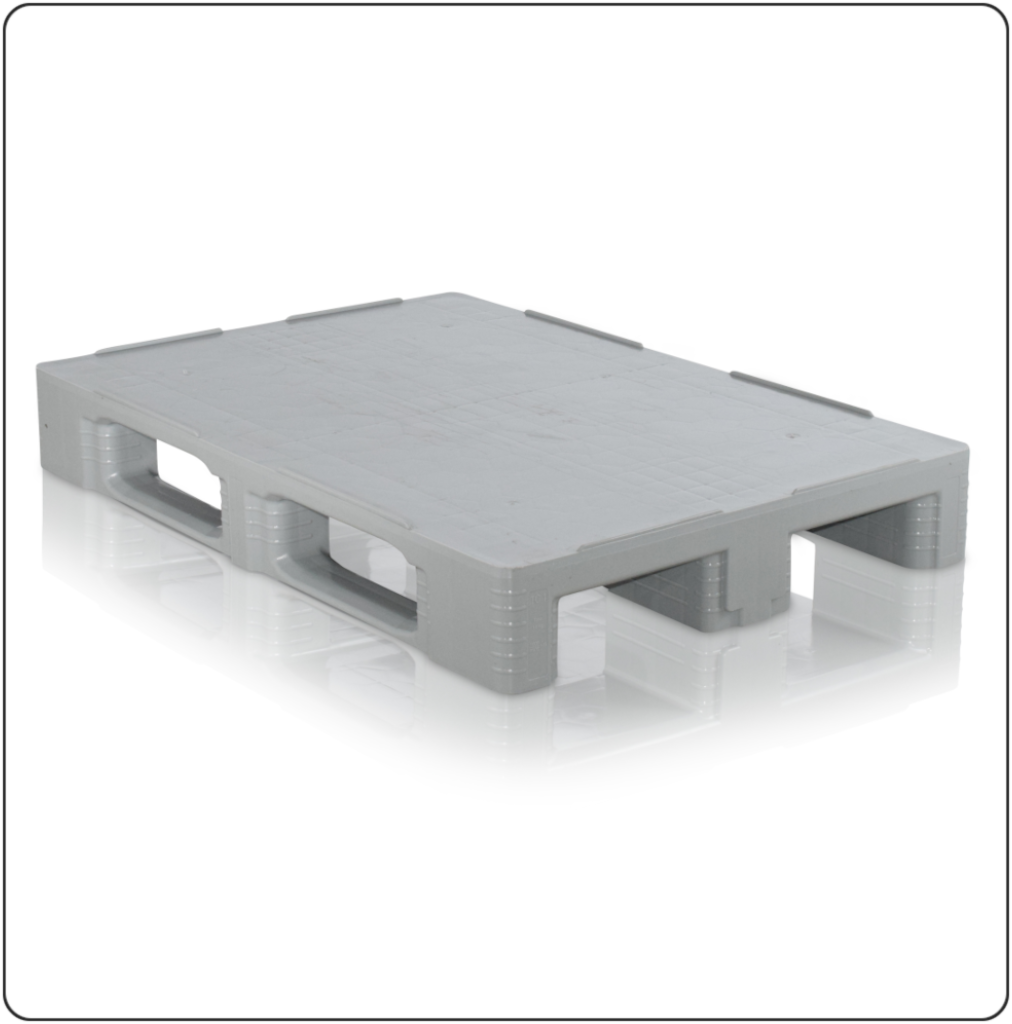
Hygienic Plastic Pallet 1200×800 mm for the Food Industry and Cleanroom Applications – 10039
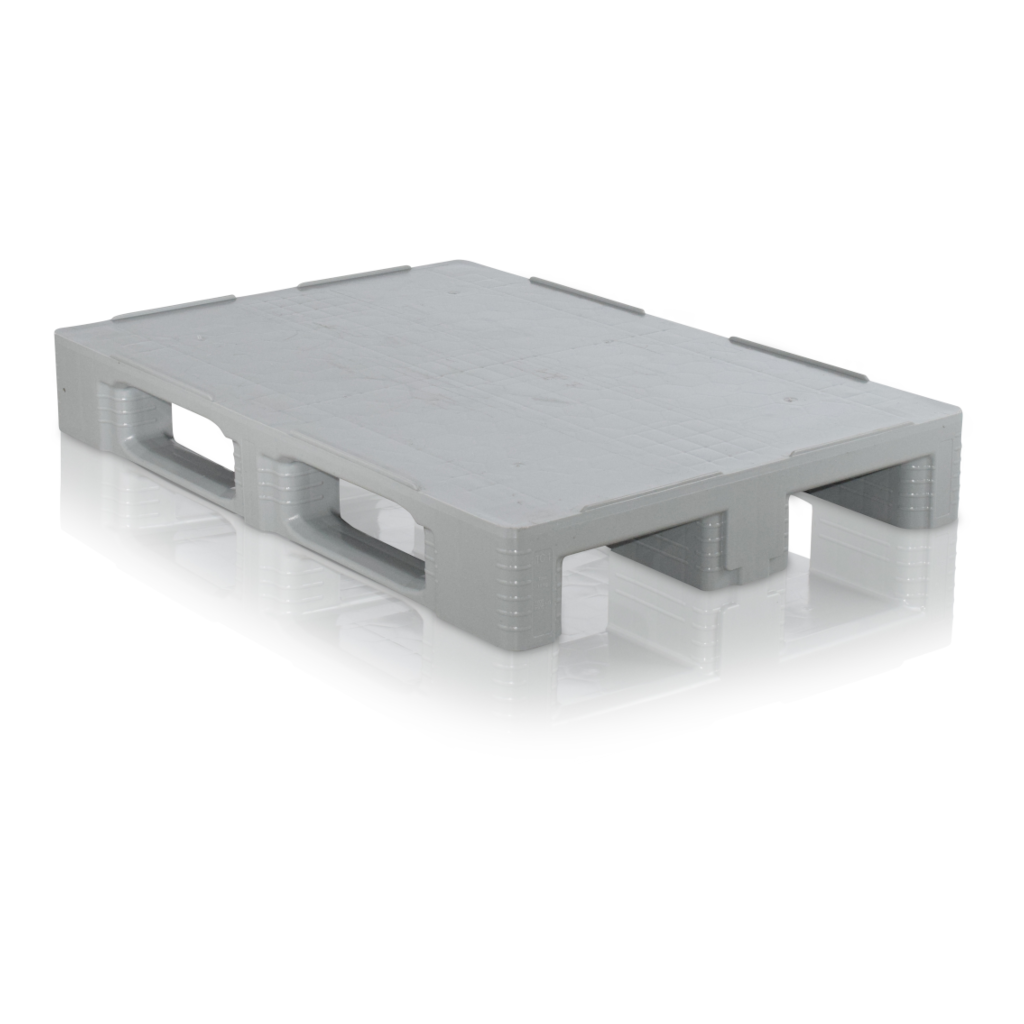
The Hygienic Plastic Pallet 1200×800 mm, Item No. 10039, is designed for applications where cleanliness, controlled material flows and consistently repeatable handling are key priorities. With a closed deck, three continuous runners and high load capacity ratings, it combines the requirements of a robust reusable pallet with a design that is particularly suitable for hygiene-sensitive production and storage areas. Typical applications include the food and beverage industry, pharmaceutical operations, medical technology, cosmetics production, cleanroom environments and the storage of sensitive technical components.
The 1200 x 800 mm Euro format facilitates integration into many existing storage, transport and goods staging processes. At the same time, the closed deck provides a largely level support surface for goods and reduces open structures on the upper surface where dirt or moisture could accumulate. The grey colour also provides a clear visual distinction from standard black industrial pallets and can therefore support allocation to defined hygiene, production or material flow areas.
Within the range of plastic pallets for storage, transport and production, the 10039 is a specialised solution for more demanding cleanliness requirements. Further formats and designs can be found in the 1200×800 mm plastic pallets category. Selection should not be based on external dimensions alone, but also on the load case, deck design, racking use, cleaning process and the requirements of the respective operating area.
Technical Data for Plastic Pallet 10039
- Item No.: 10039
- Dimensions: 1200 x 800 x 160 mm
- Weight: 18 kg
- Static load capacity: 7,500 kg
- Dynamic load capacity: 1,250 kg
- Rack load capacity: 1,000 kg
- Base: 3 runners
- Colour: grey
- Top deck: closed deck
- Option: without a rim
- Material: Polyethylene (PE)
- Manufacturing: injection moulding
- Forklift access: two-way entry with suitable forklifts and pallet trucks
The specified load capacities apply to different load conditions and must not be treated as interchangeable. For practical use, the total weight, load distribution, possible point loads, centre of gravity, support conditions, storage duration, temperature, condition of the pallet and the material handling equipment used must always be taken into account.
What the three load capacity values mean
All three load capacity ratings are relevant when selecting the correct pallet. The 1200×800 mm hygienic plastic pallet has a static load capacity of 7,500 kg, a dynamic load capacity of 1,250 kg and a racking load capacity of 1,000 kg. Each value refers to a different load condition. A high static load capacity does not therefore mean that the same load is permissible during transport or in high-bay racking.
Static Load Capacity of 7,500 kg
The static load capacity applies to a stationary pallet supported on a suitable, load-bearing and essentially continuous surface. Typical examples include floor storage or block stacking. As the pallet is not being moved, no additional forces arise from acceleration, braking, cornering or lifting movements. The load should be distributed as evenly as possible across the deck surface.
Heavy products with small contact areas require particular attention. Machine feet, narrow container runners or individual solid components can create high point loads. In such cases, localised stress may be considerably higher than the total weight would suggest. Depending on the unit load, suitable load distribution plates or plastic layer pads and separator sheets can help increase the contact area and keep individual layers of goods clearly separated.
Dynamic Load Capacity of 1,250 kg
The dynamic load capacity describes the maximum load during transport with a suitable forklift or pallet truck. During movement, additional forces act on the pallet and the load. These include lifting, setting down, acceleration, braking, cornering, thresholds, uneven floors and vibrations. For this reason, the dynamic load capacity of 1,250 kg is significantly lower than the static load capacity.
For reliable transport, the fork tines must enter sufficiently far and as evenly as possible beneath the pallet. Lifting the pallet from one side, at an angle or with only partial support can locally overload the structure. The load’s centre of gravity should also be positioned as centrally as possible. The pallet only forms the base of the unit load and does not replace suitable securing of the goods placed on it.
Racking Load Capacity of 1,000 kg
The racking load capacity is crucial when the pallet is supported on only two racking beams or comparable support lines in high-bay racking. Between these supports, the pallet spans freely and is subjected to bending. The racking load capacity of 1,000 kg is therefore a separate technical rating. With this load-bearing capacity, the 1200×800 mm hygienic plastic pallet is designed for demanding racking applications, provided that the racking geometry and unit load are suitable for the intended use.
Before use in racking, the beam spacing, support depth, load distribution, storage duration and ambient temperature should be checked. Plastic may behave differently under prolonged loading than during a short-term test. For automated high-bay warehouses, shuttle systems or stacker cranes, compatibility with sensors, transfer stations and conveyor systems must also be assessed. Damaged or permanently deformed pallets should no longer be used in racking.
Closed Deck for High Cleanliness Requirements
The closed deck surface is the central feature of this 1200×800 mm hygienic plastic pallet. Compared with an open or heavily perforated deck, the upper surface has fewer recesses and openings. This makes it easier to inspect the visible condition of the load-bearing surface and to organise cleaning procedures more clearly. At the same time, cartons, crates, closed containers and packaged goods benefit from a continuous support surface.
A closed surface does not mean that a pallet is suitable for every hygiene process without prior assessment. The underside, runners, edges and transition areas must also be included in the cleaning process. The complete operational procedure is crucial: receipt of soiled load carriers, pre-cleaning, cleaning, disinfection where required, rinsing, drying, visual inspection, approval and protected storage until the next use.
The grey colour can form part of a colour-coding system. For example, companies can assign grey pallets to a hygiene-sensitive area, a specific product group or a closed-loop reusable system. However, the colour itself does not provide evidence of hygiene. It supports operational organisation, while the actual approval status must be ensured through cleaning, inspection and internal identification.
Correctly Classifying HACCP, GMP and Cleanroom Requirements
In the food industry, the 1200×800 mm hygienic plastic pallet is primarily intended as a load carrier for packaged food, ingredient containers, cartons, crates and sealed containers. Its smooth, moisture-resistant surface supports cleaning and inspection processes. However, the pallet alone does not constitute a complete hygiene concept. Food businesses must assess potential hazards throughout the entire process and define suitable control measures.
The German Federal Institute for Risk Assessment explains the HACCP concept as a systematic approach to identifying, assessing and controlling health hazards throughout the food chain. For pallet use, this means that cleaning status, area of use, potential cross-contamination, transport routes and approval criteria should be incorporated into the company’s internal control system.
In pharmaceutical operations and medical technology, documented cleaning procedures, contamination control and traceable material flows are also key priorities. The European Commission’s GMP guidelines in EudraLex Volume 4 apply to a company’s entire quality system. A plastic pallet cannot therefore be described as generally “GMP-certified” based solely on its material. However, its closed surface and cleanability allow it to be integrated as a suitable load carrier into a GMP-oriented process.
For cleanroom environments, the cleanroom class, particle requirements, airlock procedures, cleaning methods and material approvals must be taken into account. No specific cleanroom class is stated for Item No. 10039. The suitability of the 1200×800 mm hygienic plastic pallet should therefore be assessed by the operator based on the specific cleanroom concept. This is particularly important when the pallet is introduced directly into controlled production areas.
Polyethylene Material and Manufacturing
Plastic pallet 10039 is manufactured from polyethylene using the injection moulding process. This process enables reproducible geometry and consistent external dimensions. Dimensional accuracy is particularly important in recurring logistics processes, as the pallet, racking, conveyor systems and packaging must work together reliably.
Polyethylene is moisture-resistant and, under normal operating conditions, does not absorb water in the same way as absorbent wood. As a result, the pallet does not swell when exposed to moisture, and its tare weight is not altered through water absorption. This is particularly advantageous in washing areas, chilled zones, beverage production and other wet operating environments. The splinter-free surface also reduces the risk of loose wood fragments or protruding nails.
The 1200×800 mm hygienic plastic pallet is resistant to many commonly used cleaning agents and disinfectants. However, specific compatibility depends on the active agent, concentration, temperature, contact time and frequency of use. When aggressive substances or specialised cleaning processes are involved, material compatibility should be checked before routine use. No binding temperature range is stated in the available product data and should therefore be clarified separately for deep-freeze applications, hot cleaning processes or conditions involving significant temperature fluctuations.
Cleaning, Disinfection and Drying
A pallet suitable for hygienic applications only delivers its full benefits when used in conjunction with a defined cleaning process. Before cleaning, the pallet should be inspected for visible contamination, cracks, deformation and damage to the runners or deck surface. Coarse residues should be removed before cleaning agents or disinfectants are applied.
The process should be adapted to the type of contamination and the required operational hygiene level. Both manual and automated cleaning processes are possible. The dosage, contact time, water temperature, mechanical action and subsequent rinsing must be matched to the material. After cleaning, sufficient drying is important to prevent residual moisture from being carried into the next stage of the process.
The cleaning frequency cannot be determined solely by the number of reuse cycles. It depends on the area of use, product group, risk of contamination and specific incidents such as leaks or contact with the floor. In controlled areas, a clear separation between uncleaned, cleaned and approved pallets may be advisable. The grey colour supports visual organisation but does not replace documented status labelling.
Handling with Forklifts and Pallet Trucks
The three continuous runners allow two-way entry with suitable forklifts and pallet trucks. Before introducing the pallet into an existing operation, the entry height, fork width, fork spacing, roller position and insertion depth should be checked. Not every pallet truck or automated material handling system is compatible with every pallet with runners without prior testing.
The complete unit load must be taken into account during transport. The pallet weight of 18 kg must be added to the load weight. Drivers should avoid sudden movements and adjust their speed to the floor conditions, bends, ramps and visibility. When configuring the unit load, both the pallet’s load-bearing capacity and the stability of the stacked goods, including their resistance to shifting or tipping, must be considered.
Load Securing on the Hygienic Pallet
The 1200×800 mm hygienic plastic pallet provides a robust base but does not replace professional load securing. The DGUV publication “Securing Palletised Unit Loads” outlines fundamental requirements and possible securing methods for transport, storage and stacking. The measures required depend on the goods, packaging, centre of gravity, transport route and the forces involved.
Depending on the application, stretch film, strapping, edge protection, anti-slip layer pads or form-fit packaging systems may be suitable. For cartons, crates, bottles, cans or packaged goods, reusable plastic pallet layer pads can separate individual layers of goods and support load distribution. For round or cylindrical goods, pallet wedges for load securing may also need to be considered.
The optional version without a rim may be suitable where cartons or containers need to sit flush with the deck surface or where a rim would interfere with the packaging dimensions. Where compatible with the unit load, an existing rim can help with positioning. The decision should be based on the actual product dimensions and the conveyor systems used.
Stackability, Storage and Return Handling
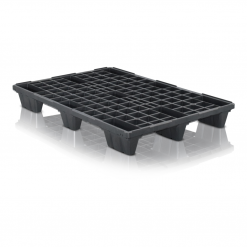
When empty, several pallets can be stacked on top of one another. This allows the available storage space to be used efficiently during staging and return handling. As the 10039 has three continuous runners, it is not a nestable pallet. The actual stacking height must be adapted to the floor level, available room height, operational safety requirements and the stability of the empty pallet stack.
Cleaned pallets should be stored in a way that protects them from recontamination. In a reusable cycle, a clearly defined process is recommended from return handling through cleaning and inspection to reissue. Damaged pallets should be removed from service to prevent them from being returned inadvertently to racking, production or a hygiene-sensitive area.
In repeated reuse cycles, the combination of a dimensionally stable design, moisture resistance and consistent geometry can offer economic benefits. The actual service life depends on the loads applied, temperature, travel routes, cleaning chemicals and careful handling. No standard number of reuse cycles is specified for Item No. 10039.
Advantages over wooden pallets
- No ISPM 15 treatment required for the plastic pallet for export
- Splinter-free and without protruding nails
- Moisture-resistant and weather-resistant
- Fully enclosed pallet with a readily inspectable support surface for goods
- Easy to clean and disinfect
- No swelling due to water absorption, unlike wood
- Reproducible dimensions for standardised processes
- Dimensionally stable when used correctly in reusable applications
- Consistent quality over repeated reuse cycles
- Clear visual identification through the grey colour
An important distinction must be made in international trade: ISPM 15 does not regulate general operational hygiene, but sets phytosanitary requirements for certain wood packaging material. As the 1200×800 mm hygienic plastic pallet is made from PE, it does not require the relevant wood treatment or ISPM 15 marking.
If a shipment also contains raw wood components such as crates, wooden beams or dunnage, these must be assessed separately. Country-specific import regulations and requirements for the complete export packaging also remain applicable. The choice of pallet material therefore does not replace an assessment of the entire packaging and shipping concept.
Applications for Plastic Pallet 10039
Food and Beverage Industry
The 1200×800 mm hygienic plastic pallet is suitable for packaged food, sealed raw material containers, cartons, crates and packaged goods. Typical areas of use include goods receiving, production, packaging, chilled areas, interim storage and shipping. The closed deck facilitates visual inspection and supports defined cleaning processes. For direct contact with unpackaged food, the required documentation for the specific application must be checked.
Pharmaceuticals and Medical Technology
In pharmaceutical and medical technology operations, the pallet can be used for packaged starting materials, components and finished goods. Documented cleaning status, controlled transfers between areas and clear traceability are essential. Its suitability must be integrated into the quality management system of the respective operation.
Cleanroom and Controlled Production Areas
The smooth plastic surface and closed deck are designed for high cleanliness requirements. Before approval for cleanroom use, however, particle requirements, transfer procedures, cleaning methods and material compatibility must be assessed. No specific cleanroom class has been confirmed for the 10039.
Cosmetics Industry
In the manufacture and packaging of cosmetic products, the grey hygienic pallet supports clearly organised material flows. It can carry packaged raw materials, containers, packaging materials and finished goods, provided that load distribution and cleaning requirements are taken into account.
Sensitive Technical Components
Optical, electronic and precision-engineered components are also frequently moved in clean assembly and storage areas. The pallet provides a closed support surface for suitable containers and packaging. No ESD suitability is specified for the 10039 and must not be assumed.
Difference from Semi-Hygienic Pallets and Standard Pallets
Compared with semi-hygienic pallets, the 1200×800 mm hygienic plastic pallet is consistently designed for controlled cleanliness areas. The grey colour and closed deck support clear allocation to food, pharmaceutical or cleanroom processes. For standard applications without specific hygiene requirements, a lighter or more simply constructed pallet may be the more economical choice.
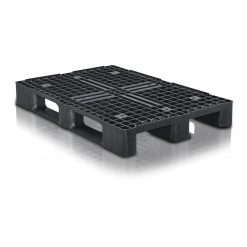
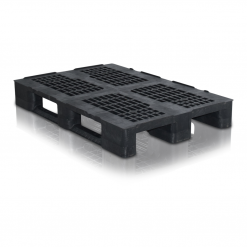
The semi-hygienic pallet 10367 with an open deck is an alternative where air circulation, water drainage or an open design are required. The semi-hygienic pallet 10369 with a closed deck can be considered for robust standard, export and industrial processes. For conventional transport and storage tasks with a lower tare weight, the plastic Euro pallet 10361 is also available.
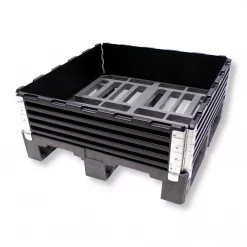
If standard dimensions, the base design or equipment do not suit the process, custom-built plastic pallets offer a way to adapt the geometry and structural features to specific goods or conveyor systems. For additional lateral stability or product protection, 1200×800 mm plastic pallet collars can also be considered. Compatibility must always be assessed based on the specific pallet and unit load.
Decision Support for Procurement and Logistics Planning
Item No. 10039 is particularly suitable where a closed deck, the 1200 x 800 mm Euro format and high load capacities are required in combination. However, procurement decisions should not be based solely on dimensions and maximum load capacity ratings. The decisive factor is whether the pallet is suitable for the entire process.
- What goods and packaging are transported on the pallet?
- How is the weight distributed across the deck surface?
- Are there any small or sharp-edged point loads?
- Will the pallet be used in floor storage, block stacking or high-bay racking?
- What are the beam spacing and support depth?
- Which forklifts, pallet trucks or automated vehicles are used?
- Is use on roller conveyors or chain conveyors planned?
- Which cleaning agents and disinfectants are used?
- What temperatures and storage periods occur?
- Are there any requirements relating to food contact, GMP or cleanroom class?
- Is a rim required, or would the rimless version be more suitable?
- How are the pallets labelled, inspected and returned?
The more detailed this information is, the more reliably it can be assessed whether the 1200×800 mm hygienic plastic pallet is suitable for the intended process. For racking applications and automated conveyor systems, testing with the complete unit load under realistic conditions is recommended.
Frequently Asked Questions About the 1200×800 mm Hygienic Plastic Pallet
What Is a Hygienic Plastic Pallet?
A hygienic plastic pallet is a reusable load carrier whose surface and design are intended to support well-controlled cleaning processes. The 10039 features a fully enclosed design, three continuous runners and a grey colour for clear visual allocation in sensitive operating areas.
Is the Pallet Suitable for Direct Food Contact?
The pallet is designed for the transport and storage of packaged food. For direct contact with unpackaged food, the required material and conformity documentation must be checked for the specific application. No general approval is stated in the available product data.
Does the Pallet Meet HACCP Requirements?
The closed, easy-to-clean design can support a HACCP-based hygiene concept. However, HACCP applies to the entire operational process. Cleaning, status labelling, transport routes and potential cross-contamination must be taken into account in the company’s hazard analysis.
Is the Pallet GMP-Certified?
No general GMP certification is stated for Item No. 10039. Due to its design, the pallet can be used in GMP-oriented areas, provided that the operator integrates it into its cleaning, quality and approval processes.
Is the Plastic Pallet Suitable for Cleanroom Use?
The 10039 is designed for applications with high cleanliness requirements and for use in cleanroom environments. No specific cleanroom class is stated. Particle requirements, cleaning processes and transfer procedures must therefore be assessed for the specific application.
Why Is the Hygienic Pallet Grey Instead of Black?
The grey colour makes it easier to distinguish the pallet visually from standard black industrial pallets. It can be used to assign pallets to specific hygiene zones, product groups or reusable circulation systems. However, the colour itself does not constitute proof of hygiene.
Can the Pallet Be Cleaned and Disinfected Repeatedly?
Yes. The 1200×800 mm hygienic plastic pallet is designed for reusable applications and repeated cleaning. Compatibility with the relevant agent depends on the active substance, concentration, temperature and contact time and should be checked when aggressive cleaning processes are used.
What Is the Pallet’s Load Capacity?
The static load capacity is 7,500 kg, the dynamic load capacity is 1,250 kg and the racking load capacity is 1,000 kg. The applicable value depends on the specific load condition. These ratings assume suitable load distribution, appropriate support conditions and an undamaged pallet.
What Is the Difference Between Static and Dynamic Load Capacity?
The static load capacity applies when the pallet is stationary on a suitable support surface. The dynamic load capacity applies during transport with a forklift or pallet truck. Movement, braking forces and uneven floors mean that the dynamic load capacity is lower.
Can the Pallet Be Used in High-Bay Racking?
Yes, a racking load capacity of 1,000 kg is specified for the 10039. Before use, the beam spacing, support depth, load distribution, storage duration and temperature must be checked. The static load capacity of 7,500 kg must not be used as the racking load capacity.
Is the Pallet Stackable or Nestable?
When empty, the pallets can be stacked on top of one another. Due to the three continuous runners, the pallet is not described as nestable. Empty pallet stacks must be placed on a level surface and secured against unintended movement.
Can the Pallet Be Used with Pallet Trucks?
Yes, the pallet can be handled from two sides using suitable pallet trucks and forklifts. The entry height, fork rollers, fork spacing and insertion depth should be checked against the equipment used in the operation.
Does the Plastic Pallet Require ISPM 15 Treatment for Export?
No. ISPM 15 applies to certain types of wood packaging material. The plastic pallet itself does not require the corresponding wood treatment. However, any additional raw wood components in the shipment must be assessed separately.
Is the Pallet Suitable for Deep-Freeze Areas?
Polyethylene is commonly used in wet and chilled environments. However, no binding temperature range is specified for the 10039. Suitability should therefore be assessed individually before use at deep-freeze temperatures or under conditions involving frequent temperature changes.
Can the Pallet Be Used on Conveyor Systems?
Use on roller conveyors, chain conveyors or automated systems may be possible. The runner support, conveying direction, transfer points, sensors and complete unit load must be checked. The standard dimensions alone do not constitute automatic approval for use with the system.
How Does the 10039 Differ from a Semi-Hygienic Pallet?
The 10039 is more specifically designed for hygiene-sensitive areas, cleanroom processes and clear visual identification. Semi-hygienic pallets may be more economical for standard, industrial or export applications. The decision depends on the deck design, cleaning requirements, load capacity and process requirements.
Is the Pallet Recyclable?
Polyethylene is generally suitable for material recycling. Actual recyclability depends on the pallet’s condition, any contamination and the available take-back or disposal routes. Contaminated pallets may be subject to specific disposal requirements.
What information is needed for an inquiry?
Useful information includes the required quantity, delivery location, preferred delivery date, type and weight of the goods, load distribution, racking type, conveyor systems, temperature range, cleaning process and the required version with or without a rim. For regulated applications, the required documentation and approval criteria should also be specified.
Enquire Now About the 1200×800 mm Hygienic Plastic Pallet
Are you looking for a reliable hygienic pallet for the food industry, pharmaceutical production, medical technology or cleanroom applications? The 1200×800 mm hygienic plastic pallet 10039 combines a closed deck, three continuous runners and high load capacity ratings with a moisture-resistant, easy-to-clean PE design. Send us your requirements regarding quantity, load type, racking use, cleaning process and preferred version. We will be pleased to advise you on delivery times and the most suitable pallet solution: info@plasticunion.com.